The 1904 Olympics in St. Louis were already strange — attached to the World’s Fair and stretched over months. But nothing compared to the marathon, run on August 30 in brutal 90-degree heat, over dusty unpaved roads, with organizers providing almost no water on purpose. The race’s chief organizer wanted to test his theories about “purposeful dehydration.” What followed was pure chaos.
Fred Lorz, a New York bricklayer, was the first to cross the finish line. The crowd roared, and he was moments from receiving the trophy when the truth emerged: Lorz had suffered cramps at mile nine, hitched a ride in a passing automobile, waved at spectators from the car for eleven miles, and then — when the car overheated — hopped out and jogged the rest of the way in. He claimed it was a joke. Officials were not amused.
The actual winner, British-born American Thomas Hicks, had a finish that was arguably even wilder. Exhausted and begging to lie down miles from the end, Hicks was kept moving by his handlers, who administered doses of strychnine — a rat poison that acts as a stimulant in tiny amounts — mixed with raw egg whites, followed later by more strychnine and swigs of French brandy. It was, in effect, the first documented case of performance “enhancement” in modern Olympic history, and it nearly ended him. Hicks crossed the line supported by his trainers, hallucinating, and had to be carried off. He reportedly lost eight pounds during the race.
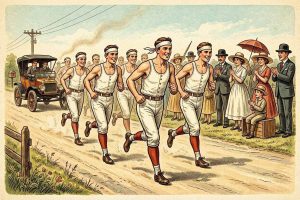
The rest of the field provided the comedy. Cuban postman Félix Carvajal — who had raised his travel money by running exhibitions in Havana and lost it all in New Orleans — showed up at the start line in street clothes; a fellow athlete cut his trousers into shorts. Mid-race, Carvajal detoured into an orchard to snack on apples, which turned out to be green. Stomach cramping, he lay down for a nap — and still finished fourth. Len Taunyane of South Africa, one of the first Black Africans to compete in the Olympics, was chased nearly a mile off course by aggressive dogs and still finished ninth.
Of 32 starters, fewer than half finished. Officials seriously discussed banning the marathon forever.
Instead, it survived — and 1904 remains the gold standard for sporting absurdity, a race so ridiculous that no scriptwriter would dare invent it.